Agentic Tax Compliance
Finduku
A tax compliance platform for Philippine businesses — invoicing, books, returns, and filing handled end to end, so every deadline arrives already prepared.
- Tax Returns
- Books of Accounts
- E-Invoicing
- Expense Management
- AI Assistant
- My role
- Co-founder, product architecture, and full-stack build
- The project
- A tax compliance platform built as a company, not a demo
- Product focus
- Tax compliance platform for Philippine businesses
<Product Overview/>
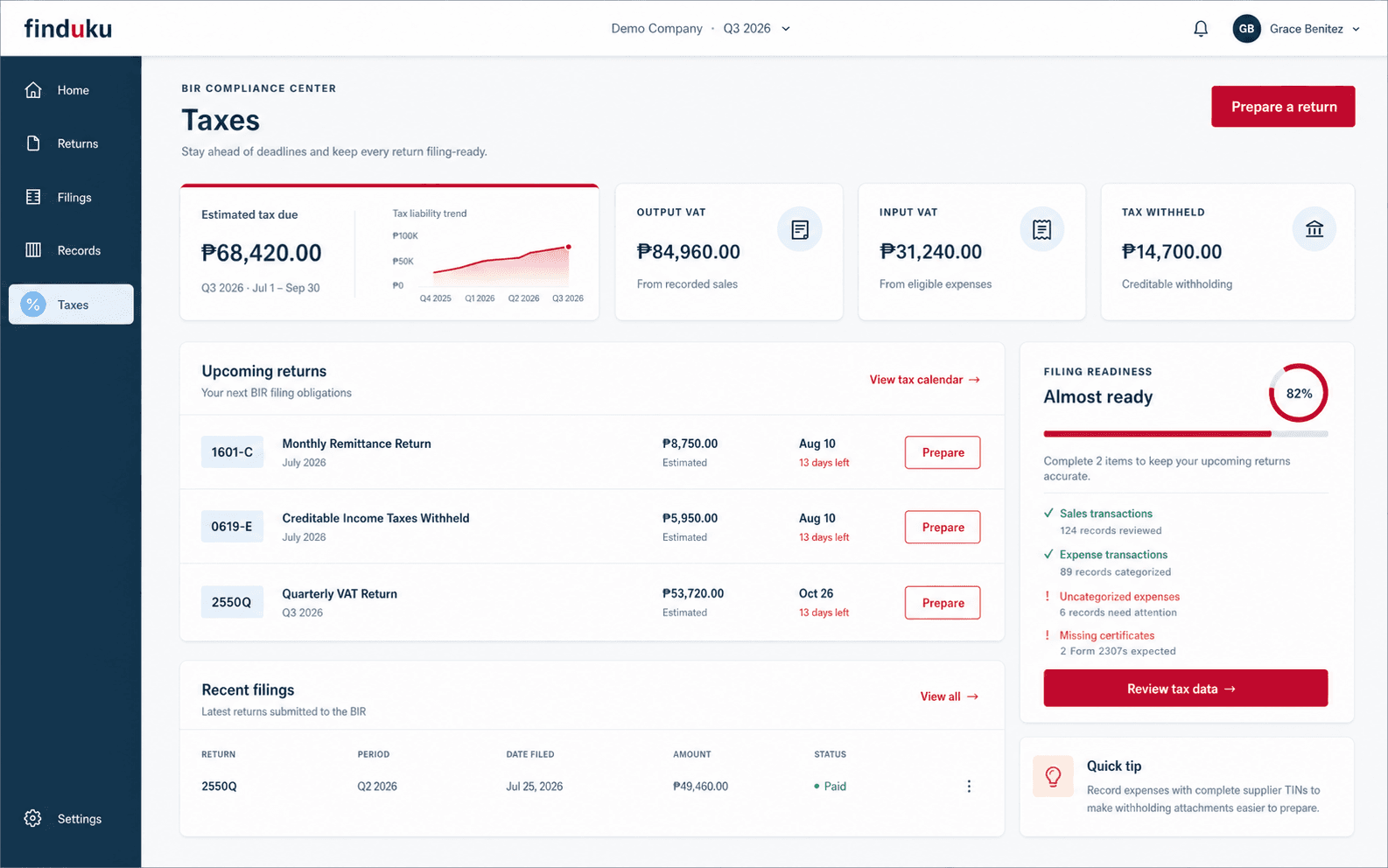
Most Philippine businesses still do compliance by hand — spreadsheets, manual encoding, and a scramble before every deadline. Finduku makes it something the platform handles.
The problem
Compliance work is repetitive but unforgiving. Invoices must follow a prescribed format, books must be maintained in a prescribed way, returns must reconcile to both, and a small encoding error found months later becomes a penalty. Most businesses handle it manually, or pay someone to redo the same work every quarter.
The solution
Finduku covers the full compliance chain in one platform: compliant invoicing, expense capture, books of accounts, tax computation, and return preparation. Because every stage feeds the next, the data is entered once and everything downstream is derived rather than re-encoded by hand.
The approach
The platform is agentic, not merely automated. Classification, validation, and computation happen as the work arrives, with an AI assistant that can answer questions about a business's own data and cite the regulation behind an answer. Anything consequential is confirmed by a person before it goes out.
What it delivers
Deadlines that arrive as review rather than preparation. Books stay current instead of being reconstructed, invoices are correct at the moment they are issued, and by the time a return is due the numbers behind it are already assembled and traceable.
<Product Features/>
The core workflows and modules that make up the product.
Compliant Invoicing
Issue invoices that meet the required format every time, with the right tax treatment applied automatically and corrections handled without breaking the audit trail.
Books of Accounts
Generate and maintain the books of accounts directly from recorded transactions, so they stay complete, formatted correctly, and always up to date.
Tax Computation & Returns
Compute VAT, percentage, withholding and income taxes from recorded transactions, then prepare and file the corresponding returns for each period.
Electronic Invoice Compliance
Transmit invoice data to the BIR in the required format, signed and encrypted, so each issued invoice is reported as it happens, with proof of submission retained.
Expense Management
Capture business expenses from receipts, manual entry, or uploads, so input tax and allowable deductions are recorded correctly for the period.
AI-Assisted Onboarding
Onboard a business through a guided setup that captures its registration details, registered tax types, filing obligations, and deadlines.
<The AI Layer/>
Built into the modules where the compliance work happens rather than bolted on the side, with every answer and decision showing where it came from.
The Agent
One agent, four skills — Duku handles invoicing, expenses, tax, and your questions.
Invoices
Catches duplicates and encoding errors before an invoice is issued, applies the right VAT treatment, and drafts follow-ups on overdue invoices.
Taxes
Handles the calculation, preparation, and filing of taxes — VAT, percentage tax, withholding, and income tax — for each period from recorded transactions.
Expenses
Reads each captured receipt, applies the correct tax treatment, and records it against the right account without waiting for filing season.
Duku as Assistant
Answers a user's questions about their own account and data, grounded in retrieved regulation and their actual records rather than in model memory.
How Autonomy Is Scoped
Act
Routine classification and computation run on their own, so the work that is unambiguous does not wait on a person to confirm the obvious.
Confirm
Anything with consequence is proposed by the agent and confirmed by the user before it takes effect — nothing consequential happens silently.
Escalate
Genuinely difficult calls are escalated for professional review rather than guessed at, because a wrong answer in compliance surfaces months later as a penalty.
How It Is Built
Grounded, not remembered
Regulations are retrieved from a vector index and combined with the business's own records through tool access. Answers cite what they relied on, because a compliance answer without a source is not an answer.
Orchestrated with LangGraph
Agent work runs as graphs rather than prompt chains, giving branching, looping, shared state, and explicit human-in-the-loop stops — the structure the three zones above actually need to exist.
A voice built for the subject
Duku is written to four pillars: clear, caring, confident, and cautious. Tone matters here — the user is often anxious, the subject is unforgiving, and false confidence is worse than saying a question needs a professional.
- Retrieval Grounding
- Evidence Citation
- Confidence-Based Routing
- Human Confirmation
- Professional Escalation
<How It Works/>
The compliance chain and engineering decisions that keep tax data consistent, traceable, and ready to file.
Architecture Flow
Data moves through a seven-step lifecycle, from source document to filed return.
- 01
Capture
Invoices, expenses, and transactions enter the platform from issuance, upload, or import, against the right taxpayer and period.
- 02
Validate
Check each record for completeness and consistency — required fields, supporting details, duplicates — before it is allowed to affect anything downstream.
- 03
Classify
Determine the tax treatment: VAT status, withholding applicability, deductibility, and the accounts the entry belongs to.
- 04
Record
Post the entry to the ledger and the books of accounts, so the books reflect activity as it happens rather than at period close.
- 05
Compute
Derive the tax figures for the period — output and input VAT, withholding, percentage tax, income tax — from the recorded data rather than a separate worksheet.
- 06
Review
Present the prepared figures for confirmation, with each number traceable to the transactions behind it and exceptions surfaced for attention.
- 07
Transmit
Sign, encrypt, and submit what must be transmitted, with retries and status tracking, and retain proof of filing against the period.
Engineering Decisions
System choices that keep compliance processes transactional and auditable.
One transactional system
An invoice touches tax, books, and filing at once, so the platform keeps compliance data in one system with clearly separated modules and real transactional guarantees. Splitting it across services would mean an invoice could post while its tax entry silently failed — the one outcome compliance cannot tolerate.
Explicit state transitions
Documents move through explicit, enumerated states with only legal transitions between them, enforced in one place and backed by database-level constraints. A voided invoice cannot quietly become editable, and a state change is atomic, because in compliance the audit trail is the product.
No silent failures
Submission to the BIR is signed, encrypted, batched, and retried within the window allowed, with every attempt and response retained. BIR systems go down, and the worst outcome is a business believing it filed when it did not — so every submission carries a status the user can see and act on.
<Technology Stack/>
The technologies, frameworks, and standards used to build the product.
Backend & Data
- Django
- PostgreSQL
- Celery
- Redis
- Google Cloud Run
- Docker
- Google Cloud SQL
- Google Cloud Storage
- Gunicorn
AI & Documents
- LangGraph
- Gemini on Vertex AI
- FastAPI
- pgvector
- Google Cloud Document AI
- Vertex AI Text Embeddings
- LangSmith
Frontend & Mobile
- Next.js
- React
- JavaScript
- RTK Query
- REST API
- React Native (Expo)
Payments & Integration
- Stripe Payments API
- InvoicePH
- Webhooks
- Resend
- Google Cloud Pub/Sub
<Project Highlights/>
- 01
Entered once, derived everywhere
Invoices, books, and returns come from the same records, so nothing is encoded a second time.
- 02
Answers with sources
Compliance guidance cites the regulation and the underlying records behind it, never a bare assertion.
- 03
Built as a real company
Incorporated, architected, and being built for launch — not a portfolio exercise.