Invoicing & Receivables
Invoicee
An invoicing platform that gets you paid — drafting, scheduling, collections, billing, and cash flow in one place, with an AI agent handling the follow-up.
- Invoice Automation
- AI Collections
- Recurring Billing
- Linked Payments
- Accounting Integration
- My role
- Product design, architecture, and full-stack build
- The project
- An invoicing platform built around getting invoices paid
- Product focus
- Invoicing, collections, and receivables
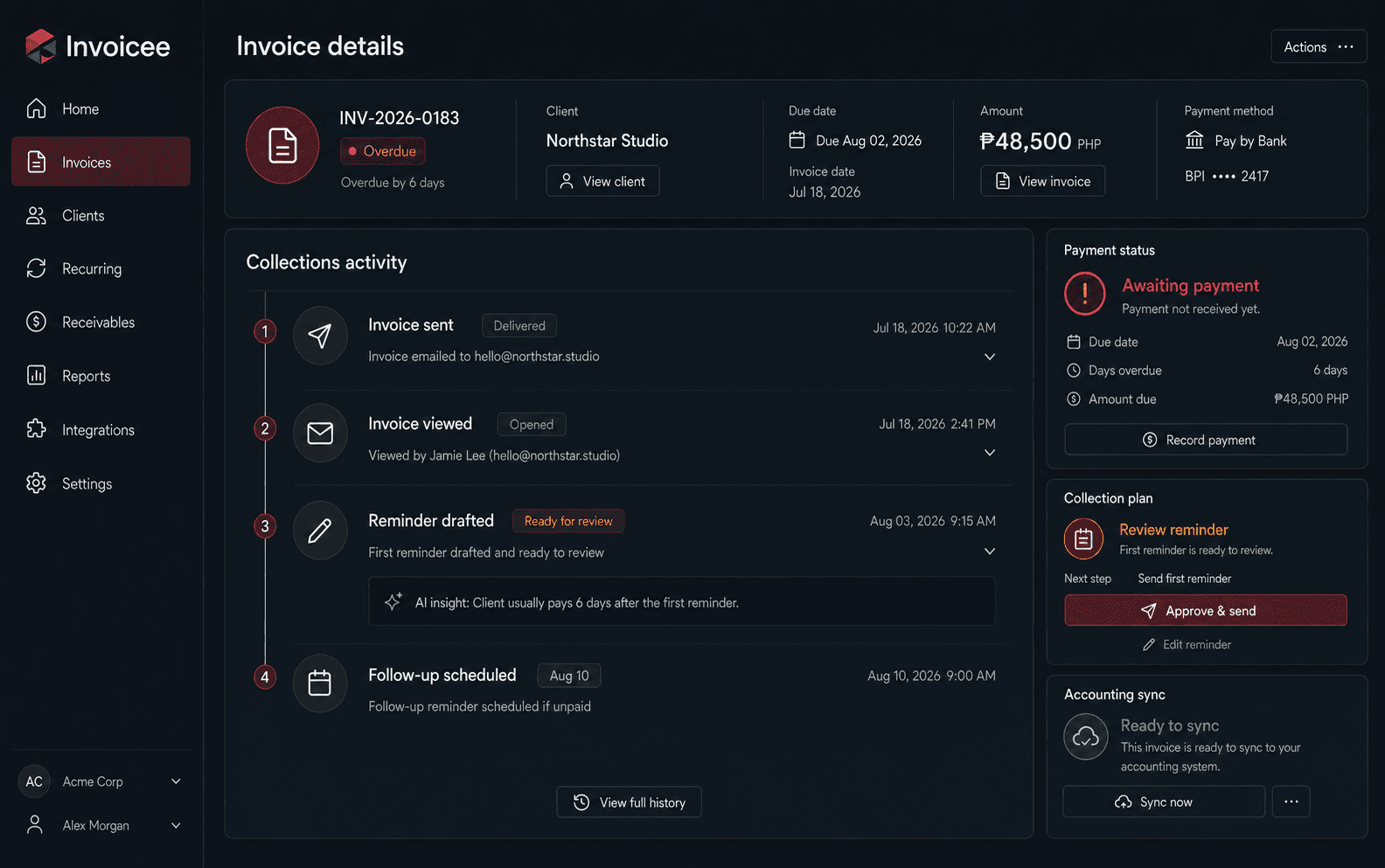
<Product Overview/>
Most invoicing tools stop at sending the invoice. Invoicee keeps going — through collections, payment, and reconciliation, until the money actually arrives.
The problem
Sending an invoice is the easy part. Getting paid means remembering who is late, deciding how hard to push, writing the follow-up, and repeating it across every client every month. Most businesses do it inconsistently or not at all, and cash sits uncollected for weeks.
The solution
Invoicee covers the whole receivable, not just the document: drafting and scheduling, delivery, payment, collections, and cash flow in one place. Clients pay through whichever methods you enable, and an AI agent handles the follow-up that usually gets forgotten.
The approach
Autonomy is scoped, not assumed. Routine reminders go out on their own, anything sensitive needs a one-tap confirmation, and accounts that need a real decision are escalated with the full history and a recommendation attached.
What it delivers
Faster payment without the awkward chasing. Clients pay through whichever methods you enable on the invoice, every payment is applied and reconciled automatically, and cash flow is forecast from how clients actually pay — not from due dates everyone ignores.
<Product Features/>
The core workflows and modules that make up the product.
Invoice Creation
Branded invoices with line items, taxes, discounts, and saved catalogs. Estimates convert to invoices in one click, and expenses can be billed straight onto them.
Recurring & Scheduled Billing
Set retainers and subscriptions to bill on their own, or draft an invoice now and schedule it to send on a chosen date or when a milestone is met.
Getting Paid
Choose which payment methods to offer and embed them straight into the invoice, so clients pay in a click. Partial payments and pay later are supported.
Client Portal & Records
Clients view invoices, download copies, and pay in one place. Each client record holds contacts, terms, billing history, and a statement of account.
Receivables & Cash Flow
Accounts Receivable aging, overdue tracking, and collections reporting in one view, with cash projected across 30, 60, and 90 days.
Accounting & E-invoicing
Invoices and payments sync to the accounting system already coded, with tax broken out correctly. Structured invoices can be exchanged over the InvoicePH network.
<The AI Layer/>
AI is used for one job in Invoicee: the follow-up nobody has time to do consistently. Everything it does is bounded, reviewable, and explainable.
What it does
The agent drafts invoices from a contract, logged time, or a delivered order, schedules delivery for when each client tends to pay fastest, and decides when and how to chase an overdue account — writing each follow-up in the right tone for that client's history.
What it will not do
Nothing reaches a client unapproved outside the bounds the business sets. Tone, frequency, and escalation limits are rules, not model discretion; anything beyond them is drafted and held for a one-tap approval.
Visible reasoning
Every decision carries its reasoning, confidence, and the history behind it. Each invoice shows what the agent did, why it chose that action, and which rules shaped its recommendation. Teams can review the evidence before approving a message, so follow-up is never a black box.
- Context-Aware Drafting
- Approval Workflows
- Rule-Bounded Autonomy
- Confidence Scoring
- Explainable Decisions
<The InvoicePH/>
An e-invoicing network for Philippine businesses — a shared rail that moves structured invoices system to system, instead of by PDF and manual encoding.
One connection, every trading partner
Without a network, every pair of businesses needs its own integration. InvoicePH uses a four-corner model instead: each business connects once to an access point, and access points exchange documents with each other.
Invoices as data, with an address
Every participant has a network ID derived from their TIN, which routes documents to the right recipient. Invoices travel as validated structured data, with delivery acknowledged end to end, so the receiving system can act on them immediately.
Compliance falls out of the document
Because the invoice is validated before it leaves the sender, tax reporting is derived from the same document instead of prepared as separate work. Nothing is re-encoded, so what the buyer receives and what the seller reports never drift apart.
Invoicee connects to InvoicePH through the same public access-point interface any third-party software would use — no private shortcut, no preferential routing, and no advantage over any other tool on the network.
<How It Works/>
The invoice lifecycle and engineering decisions that keep delivery, collections, and reconciliation reliable.
Architecture Flow
Each invoice moves through a seven-step lifecycle, from draft to payment.
- 01
Draft
Assemble the invoice from a contract, an email thread, logged time, or a delivered order, with the right rates and tax treatment applied.
- 02
Validate
Confirm the invoice has everything it needs: complete client details, amounts that reconcile, correct tax treatment, and no duplicate billing.
- 03
Schedule
Choose the send date and time based on when each client historically pays fastest, rather than whenever the invoice happens to be ready.
- 04
Deliver
Send the invoice to the client and open the payment options, then track whether it was delivered, viewed, and acted on.
- 05
Follow Up
Decide when and how to chase each client based on their payment history, and draft the message in the right tone.
- 06
Escalate
Hand over accounts that need a human decision, with the full history, what has already been tried, and a recommendation.
- 07
Record & Sync
Apply the payment, close the invoice, update receivables, and sync it to the accounting system.
Engineering Decisions
The system choices that keep customer communication controlled, invoice data consistent, and every agent action auditable.
Outbound messages are gated
The agent composes messages that reach real customers, so sending is rule-bounded rather than model-discretionary. Tone, frequency, and escalation limits are set by the business; anything outside them is drafted and held for approval. A message can never be sent twice for the same event.
Structured-first invoices
An invoice is stored as structured data, not as a rendered document. The same record produces the client-facing PDF, the accounting entry, and the network payload — so a new format or e-invoicing standard is an adapter, never a rewrite.
One source of truth
The agent runs as a separate stateless service that reads context and proposes actions; the platform owns all data and business rules. Every node's decision — input, output, reasoning, confidence — is persisted, so any invoice can replay exactly why the agent did what it did.
<Technology Stack/>
The technologies, frameworks, and standards used to build the product.
Backend & Data
- Django
- PostgreSQL
- Celery
- Redis
- Google Cloud Run
- Docker
- Google Cloud SQL
- Google Cloud Storage
- Gunicorn
AI & Documents
- LangGraph
- Gemini on Vertex AI
- FastAPI
- pgvector
- Google Cloud Document AI
- Vertex AI Text Embeddings
- LangSmith
Frontend & Mobile
- Next.js
- React
- TypeScript
- RTK Query
- REST API
- React Native (Expo)
Payments & Integration
- Stripe Payments API
- InvoicePH
- Webhooks
- Resend
- Google Cloud Pub/Sub
<Project Highlights/>
- 01
Collections that actually happen
Follow-up is decided per client and sent on schedule, instead of depending on someone remembering to chase.
- 02
Cash flow you can see coming
Projections are built from how each client actually pays, not from due dates.
- 03
One invoice, every destination
A single structured record serves the client, the ledger, and the e-invoicing network.